
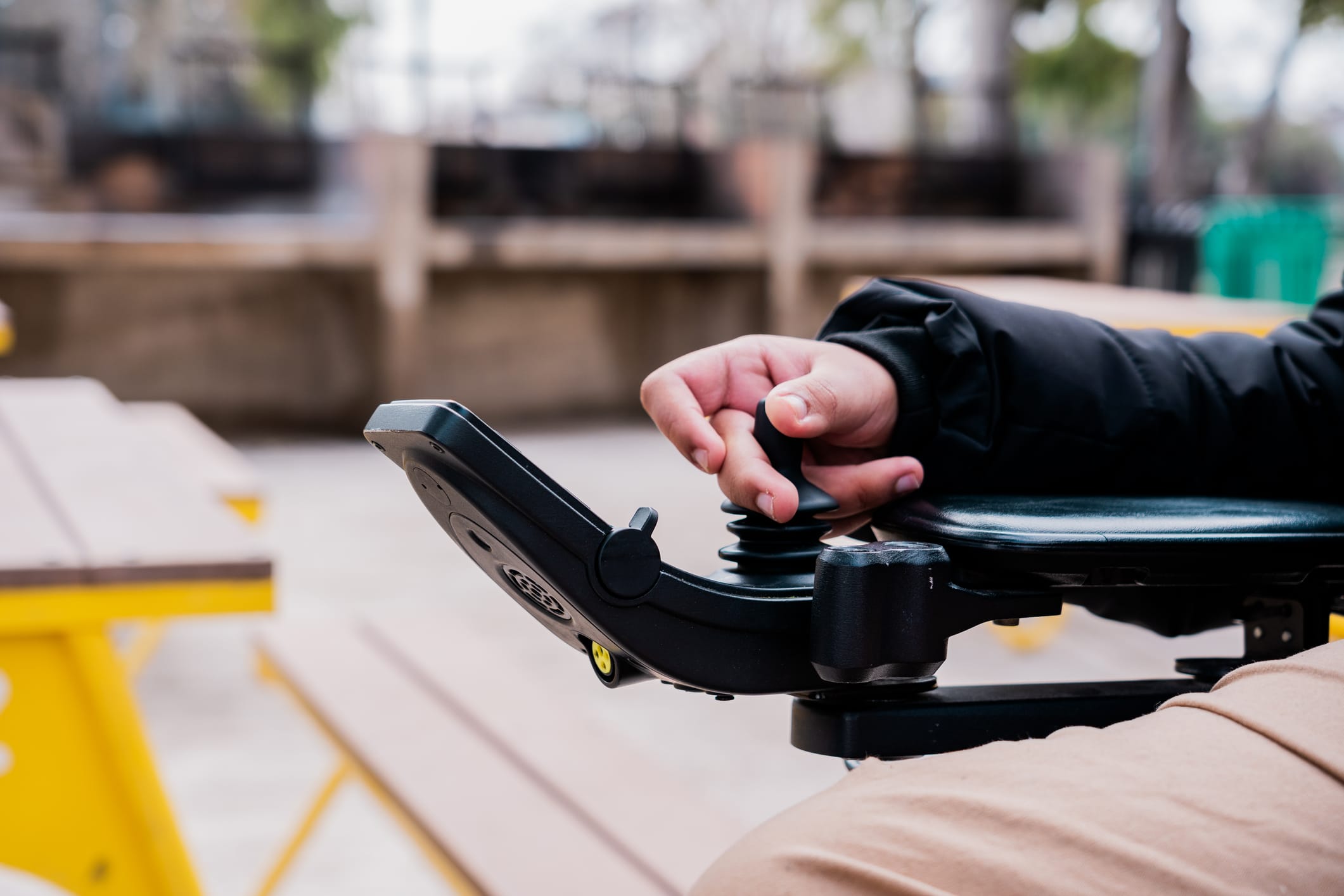
Though it can be a difficult time for parents, for boys and teens living with Duchenne muscular dystrophy (DMD) transitioning to a power wheelchair often means a sense of independence. The greater mobility offered by a power wheelchair means getting around becomes easier and a more active school and social life. But when should that transition happen?
What is a power wheelchair?
The difference between a manual and power wheelchair is clear: Manual wheelchairs require physical effort to move — either from someone pushing the chair, or the user propelling themselves — while power wheelchairs are driven via a battery-powered motor.
Power wheelchairs and scooters, however, are often confused. Though they can be used indoors, scooters are largely meant to make travelling distances outdoors easier — they’re not intended for day-long, full-time use. They have a wider turning radius, less physical support and less customization than a power wheelchair.
Scooters aren’t without benefits: They’re generally cheaper than power chairs, and often come apart for easier transport. They can be a good transitional option for boys with Duchenne who can still walk shorter distances. But they are not a permanent solution.
When are power wheelchairs recommended in DMD?
While the timeline can vary from case to case, as DMD progresses walking generally becomes more difficult during late childhood. While walking is still possible some of the time, manual wheelchairs and scooters can bridge the gap and allow boys with DMD to travel longer distances or keep up with classmates.
Eventually, though, boys will sit for most of the day. A power wheelchair usually becomes necessary between the ages of 10 and 14 when greater spinal and postural support is needed and maneuvering on and off a mobility scooter gets more difficult.
A physical therapist will support you and your family in this transition. They can help explain the many choices of power wheelchairs and provide guidance on daily use.
What are the benefits of a power wheelchair?
A customized power wheelchair offers numerous benefits for comfort and independence as mobility declines.
Independent mobility
For a time, boys and teens with DMD can propel a manual wheelchair or steer a scooter — but when arm strength declines, a power wheelchair means more freedom of movement.
- Whether across a room or across campus, a power wheelchair provides independence and freedom to move around autonomously. A survey of patients with DMD who used a power wheelchair found they unanimously agreed that it was a boost for their independence.
- Greater mobility can help patients participate more in daily activities, particularly at school and with peers. This can mean more opportunities to engage in social and community events, and less isolation.
- While power chairs are first controlled by a joystick, as mobility declines they can later be controlled by foot, head, chin or eye movements as well as sip-and-puff systems.
Postural support
When it becomes tiring to physically to sit up straight, a power wheelchair will help support good upright posture.
- A customized power wheelchair offers support for the head and spine. This is particularly important as muscle strength and control of the head and neck deteriorate.
- The seat can be customized to help with pressure management and greater comfort.
- Many power chairs offer the option of a standing function. Spending time in an upright position can help with circulation, breathing, digestion and social interaction.
Better safety
As walking gets more difficult, falls become more common. Power wheelchairs prevent this, and have other safety benefits.
- Safety features like seatbelts and chest straps reduces the risk of falls and injuries.
- A tilt function can help ease transferring into and out of the chair.
Needs change over time; as a child grows into adolescence and young adulthood, a power wheelchair can be modified to add technology and update control systems as muscle strength decreases.
Sign up here to get the latest news, perspectives, and information about DMD sent directly to your inbox. Registration is free and only takes a minute.
