
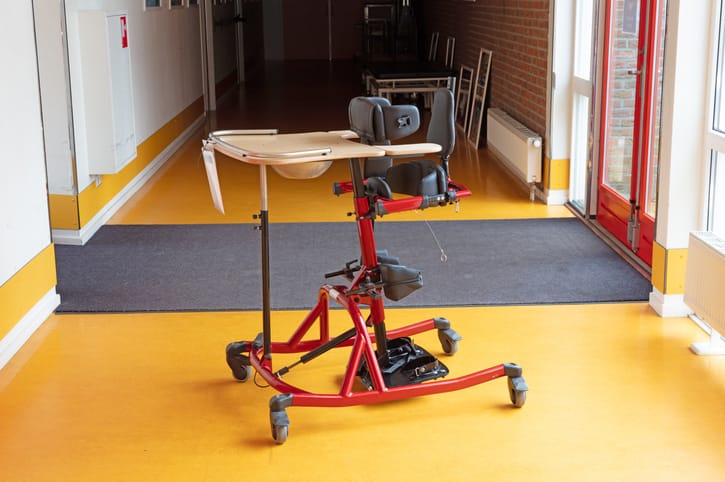
Our bodies aren’t meant to sit all day; standing frames can help with that. As muscles progressively weaken in children and young adults living with Duchenne muscular dystrophy (DMD), standing frames provide the support needed to hold the body upright for a time. Standing frames carry a number of benefits, such as maintaining bone density and improving digestion.
What is a standing frame?
A standing frame is a piece of adaptive equipment that holds someone up vertically, and is customized to suit the user. It is often made of a stainless steel frame, with a padded cushion for the knees, padded straps to hold the user in place, and a non-slip base. Many have a tray that can be used as a desk.
There are many versions of standing frames. Standing frames can be built into a wheelchair so users can more easily switch between sitting and standing. Mobile standers — essentially, wheelchairs designed for an upright user — allow people to move around while standing. Sit-to-stand frames start from a seated position before moving the user upright, making them easier for many users to get into and out of. Supine/prone standers are an option for those who can’t be fully vertical due to reduced bone density or other concerns.
How are standing frames used?
The use of a standing frame is suitable for a range of ages, from 5 to 15 years old, before the progression of DMD severely affects muscle strength. They are used in both ambulatory and non-ambulatory stages of DMD.
Because they are so many variations, the best way to help someone with DMD into a standing frame and set it up for use will depend on the specific model, and on the user. In general, the straps and supports should feel secure and snug, and the person with DMD should not feel too uncomfortable. Splints or other orthotic devices might be recommended to help provide more stability.
How long and how often to use a stander also depends on the person. For some patients a standing frame might only be recommended for 30 minutes to 1 hour at a time, once daily, while others might use one for longer or more often. Your physical therapist and healthcare team will advise on how and when it is best to use the standing frame to ensure the best outcomes.
Learn more about DMD treatment and care
What are the benefits of a stander for DMD?
A standing frame is recommended for use as part of a supported standing program in people with DMD for several reasons — but most of them tie back to the body working better in an upright position. According to some studies, standers can help in the following ways:
- Reduces the rate of scoliosis progression.
- Improves posture.
- Maintains bone density.
- Improves respiratory function by boosting lung muscle strength.
- Improves circulation.
- Improves hip and knee flexor muscle lengths.
- Reduces hypertonicity, or muscle stiffness.
- Improves range of motion.
- Improves digestive and bowel function.
- Improves sleep quality.
- Boosts morale and quality of life.
- Improves participation in activities.
The benefits of a standing frame in DMD depend on a structured schedule for the best results. In addition, occupational therapy, physical therapy, medication, stretching, assistive devices and customized home and school environments are key aspects of the effective treatment and management of DMD.
Sign up here to get the latest news, perspectives, and information about DMD sent directly to your inbox. Registration is free and only takes a minute.
