
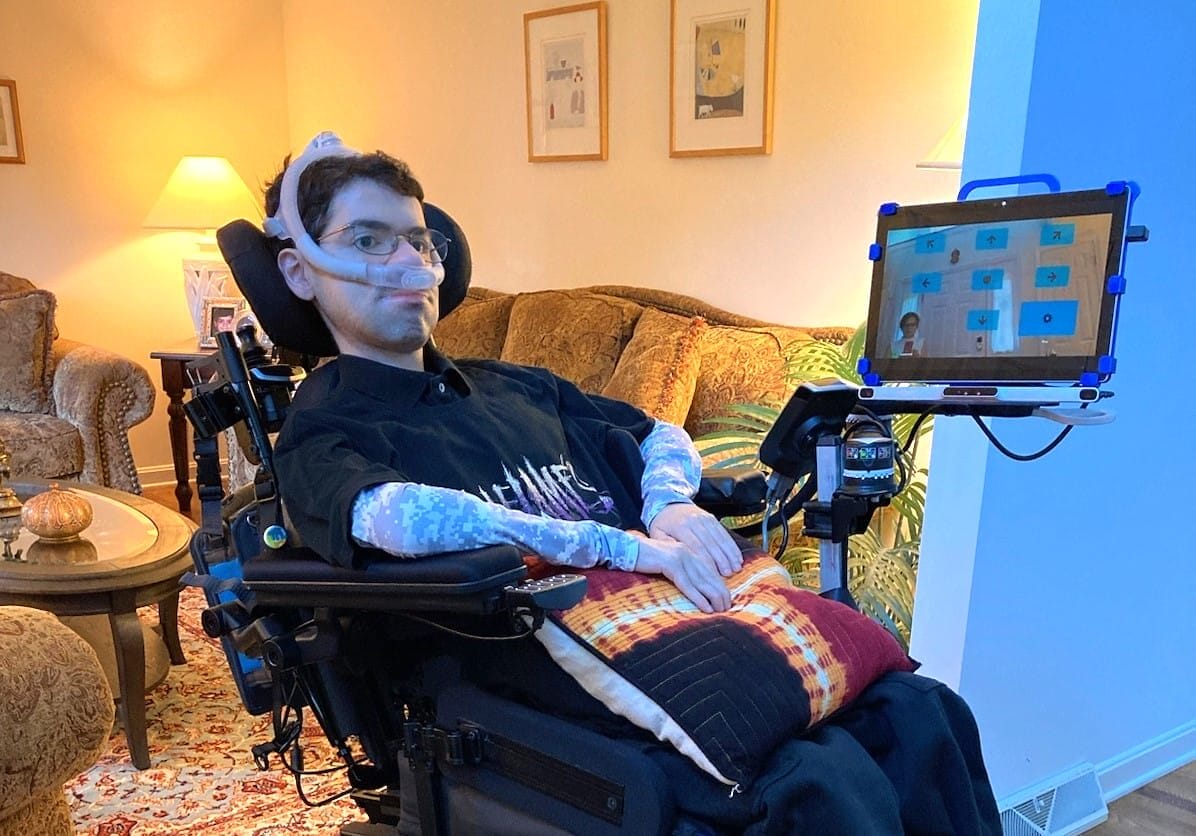
After I lost my ability to drive an electric wheelchair in 2006, my parents would control the chair with a rear attendant-drive joystick. Accustomed to voice-activated software on the computer, I would often ask them if there was a remote possibility of a voice-controlled wheelchair, but we weren’t sure or positive about it. It was extremely frustrating for me, because not being able to drive my wheelchair on my own hampered my independence of mobility. I also wanted my parents to get a break from having to drive my wheelchair practically 24/7, which made it difficult to get some time for themselves every now and then.
How I started using eye tracking technology
The COVID-19 pandemic struck in the spring of 2020, and with the resulting global lockdowns, my family and I took a more active role in researching alternative wheelchair mobility options. My physical therapist (PT) and occupational therapist (OT) suggested reaching out to a wheelchair technician at National Seating and Mobility who knew about the application of eye gaze technology to wheelchair mobility.
Eye gaze technology: What exactly is it?
Eye gaze (or eye tracking) technology is an assistive technology used to see where a person is looking on a computer or tablet screen. It allows a person to control the computer, including the mouse and keyboard, with just the motion of their eyes. For people with physical and/or cognitive disabilities caused by ALS/MND, Duchenne muscular dystrophy (DMD), cerebral palsy, autism and other rare diseases, eye gaze technology is a form of AAC (augmentative and assistive communication).
It was high time for me to get a new electric wheelchair anyway, and my PT got the ball rolling for it to include eye gaze technology. The process wasn’t easy, but my primary health insurance approved the chair with this novel technology, and eventually so did Medicaid.
The wheelchair technician came to my home to demonstrate eye tracking on a wheelchair to test drive. I successfully did a trial run, with my PT recording it on video. This video and my PT’s letter for Medicaid approval were crucial in obtaining my new wheelchair.
My experience with eye tracking technology
The new chair arrived in the winter of 2021, and I was excited to regain my independence of mobility.
What does an eye gaze system consist of?
An eye gaze system is comprised of two main parts: hardware and software. These two components are integrated to provide the necessary means for hands-free interaction, controlled entirely by the user’s specific eye movements. Let’s take a closer look at what we mean.
Hardware:
- Eye gaze/tracking camera: This processes images of the user’s eyes and tracks their positions and movements; it may use infrared light to detect the eyes.
- Processing unit: The main part of the computer system, this runs eye tracking algorithms and software.
- Display screen: This is the typical user interface for the user’s field of vision and must be positioned at eye level.
- Mount/bracket arm: This is often used to hold the tablet screen securely in front of the user’s eyes at an adjustable distance, especially if the person is immobile or a wheelchair user.
- Additional accessories: These may include head mounts, audio devices, depth sensors, external switches for environmental controls, etc.
Software:
- Eye tracking algorithms: These interpret data from the eye tracker to predict where the user is looking on the display screen.
- User interface software: This includes apps from various operating systems, eye-controlled word-processing programs, eye tracking apps, eye gaze wheelchair mobility apps, etc.
- Communication software: This may include text-to-speech apps, screen readers, word prediction apps, on-screen keyboards and mice, voice activated software, etc.
- Calibration tools: These are apps that fine tune the eye gaze system to locate the user’s eyes, their position, and their movement; this process may take up to at least a minute.
- Integration modules: Depending on the user’s needs, these additional apps may control external computers and tablets, appliances, TVs, smart devices, etc.
My wheelchair is a Quantum Q6 Edge 3. Its eye tracking hardware includes a Windows Surface tablet, the Tobii Dynavox (TD) PCEye eye tracker bar, a Mount ’n Mover bracket arm that holds the tablet in front of me at eye level once positioned and locked, and a WeatherBreaker canopy to block sunlight that interferes with the eye gaze system, causing driving problems.
The eye tracking software includes the TD Control app with eye gaze calibration, TD Eye Tracking Settings with additional calibration, and the Ability Drive app for wheelchair driving through the user’s eye movements.
My wheelchair driving experience with eye gaze technology has been generally good, particularly in wide open spaces. I don’t always have to use the weather canopy for evening activities outdoors or if it’s a nice day with not too much bright sunshine, and it functions perfectly indoors.
However, in bright sunlight with background glare, the eye gaze system stalls even with the canopy, and my transitional glasses sometimes mess up the system. As a workaround, my parents and brother innovated two side flaps and one in the front that goes over the canopy tied down with nylon straps, but it’s more of a makeshift solution. Also, I wear a pair of non-transitional glasses when maneuvering outdoors.
What are the pros and cons of eye gaze technology?
While this technology certainly has benefits worth mentioning, there may be some trade-offs as well. Consider the following if you or anyone you know is interested in using eye gaze technology.
Pros:
- Increased efficiency and productivity: Tasks can be completed quickly and effectively without too much effort.
- Enhanced user experience: The user’s eye movements make it easier to do things they otherwise cannot physically accomplish.
- Hands-free capability: There’s no need to utilize one’s upper limbs to use a computer or tablet device to type, control a mouse, surf the Internet, work remotely, communicate, etc.
- Environmental control: The user’s eye movements may control external computers, smart devices, lights, appliances, etc.
- Immersive gaming: Gamers can control gameplay just by their gaze, improving precision and providing a more accessible gaming experience.
- Controlling an electric wheelchair: This is a recent trend, with electric wheelchair users driving their chairs in the direction they’re looking at on a screen of directional arrows.
Cons:
- High cost: These systems are quite pricey, but expenses may be covered by insurance, Medicaid, public social safety nets, private agencies, vendor discounts, etc.
- Compatibility: The eye gaze system’s hardware and software must be up to date for the latest operating systems and fully compatible with them.
- Calibration requirements: Calibration may not always be accurate, so the process could require several repetitions to refresh accuracy.
- Unintentional eye movements and bright sunlight/glare: These can cause the system to stall or malfunction, especially for electric wheelchair driving; a weatherproof canopy, hat, or visor may alleviate some of these issues.
- Potential wear and tear: Though rare, sometimes overuse of certain hardware components may cause this.
Unfortunately, in the late summer of this year, a plastic lever on the bracket arm broke off, damaging the top section, making it impossible to mount the tablet, and putting my independence of mobility on hold. I immediately contacted the wheelchair technician about it, he ordered the replacement parts, and I didn’t need any approval letter. The parts arrived in due time, and the wheelchair technician advised us to be aware of how to lock and unlock the bracket arm carefully to avoid another breakage.
Sign up here to get the latest news, perspectives, and information about DMD sent directly to your inbox. Registration is free and only takes a minute.
