
I have travelled on a plane to various countries throughout my lifetime. As somebody who was born and lives in Ireland, I have been able to fly across Europe without a visa on a personal and work basis.
I have been lucky enough to fly trans-Atlantic on a couple of occasions too, but of course that involves a little bit more planning.
I love to travel and experience new cultures. I feel it is important to see the world if you are lucky to be able to do so.
I have Duchenne muscular dystrophy (DMD) and as time has gone on my condition has progressed! It means I require more planning than the average person who doesn’t have a muscle wasting disease.
It is a huge problem within our community, as people are afraid to travel by plane due to concerns about mobility aids getting damaged, restrictions on the size of mobility aids or type of batteries used, bags with medical equipment going missing or a lack of access to trained staff who can assistant you through the airport and on the plane. It can be a minefield trying to manage these things.
I want to give a bit of a guide to what I do before and after a flight to make sure things are as smooth as possible, and some of my own personal experiences with the process of having assistance before and after getting on a flight.
Preparing to fly
While booking with the airlines it is important to make sure to note you require special assistance. It is important you know the specs of your mobility aids and the type of batteries they use, as this information is usually required. It saves the hassle of having to explain at the airport.
When you arrive at the airport it is important to go to a dedicated assistance desk to make sure your assistance is booked in correctly! At that desk they will ask you if you need assistance through the airport or just to meet you at the gate. Sometimes you may have to go to a bag check-in desk if a dedicated assistance desk isn’t available.
The next step will be going through security. Security can be a tricky one, as different airports may require you to do different things! I make sure to bring a medical bag with me as a carry-on bag, so it doesn’t go missing. Just tell the people working in security it’s a medical bag scanning through.
If you have a medical aid, most likely you won’t be asked to go through the metal detector. You will get pulled to the side and patted down. They will ask if you have any pain anywhere. I have been told sometimes that they want to scan my wheelchair seat cushion; I explain that I can’t stand and ask for the manager, and they’ve said it would be ok if I go through.
Once through that process it’s quite easy. It’s just about getting to the gate once the gate number is announced and not missing your flight.
Boarding the plane
Once you get to the gate you may just have to wait until the staff start boarding. Many times in a big airport I have been transferred by an accessible bus to another terminal in the airport.
When I get to the gate I go up to the boarding staff check-in and let them know I’m here, as they need to let the assistance team know I’m waiting for them. Sometimes they don’t let you check in until assistance comes.
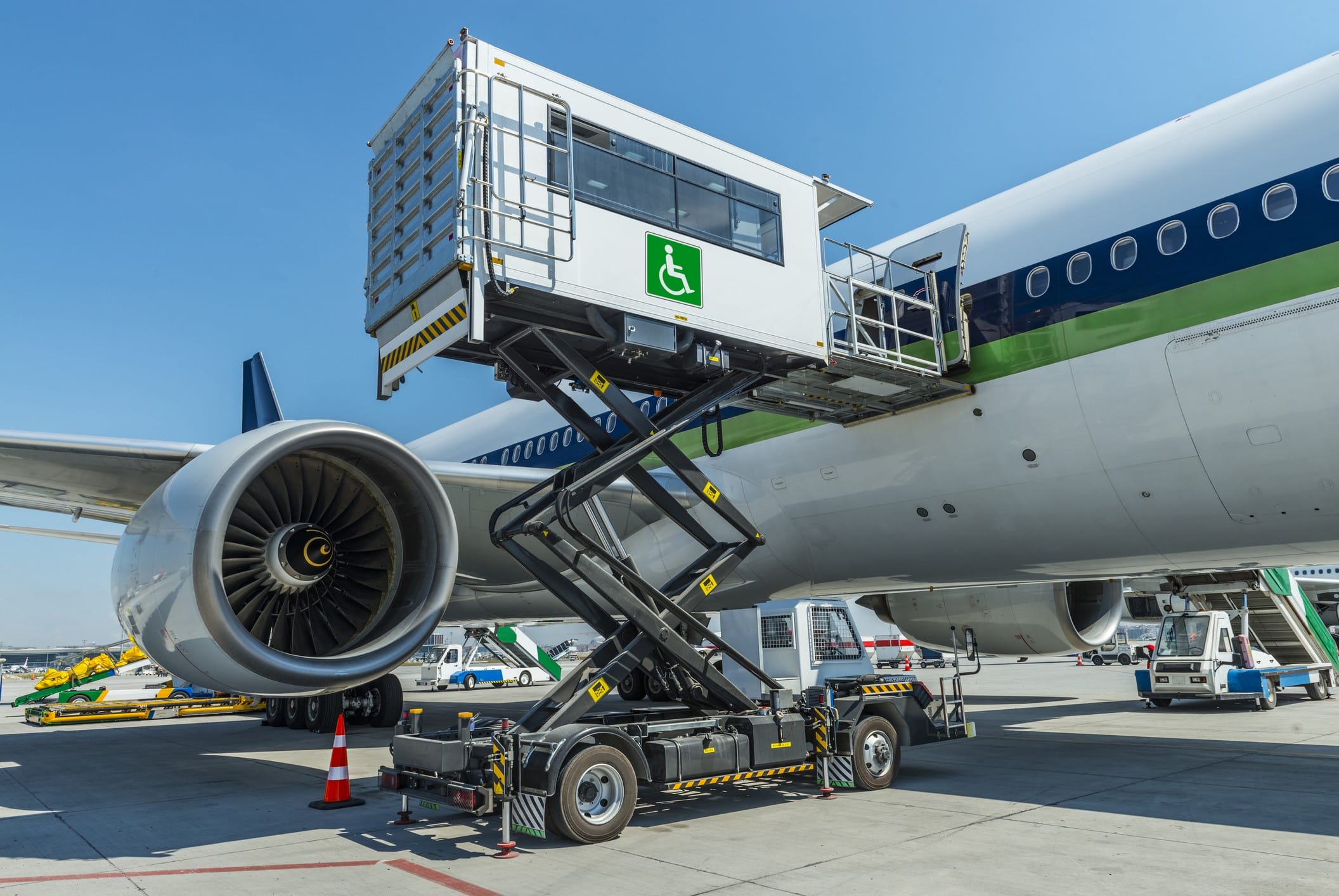
Most times flying within Europe you won’t board via a bridge that is attached to the plane, but instead with an “ambulift,” a specialized airport vehicle with a liftable cabin.
Once the assistance arrives at the gate, they usually take me down in a lift to where the ambulift is parked. I get into the ambulift, and they clamp my wheelchair down to the floor. They then drive the ambulift to the opposite side of the airplane where people aren’t boarding, and park beside it.
The magic happens when the ambulift starts to go up, just like you’re in a lift.
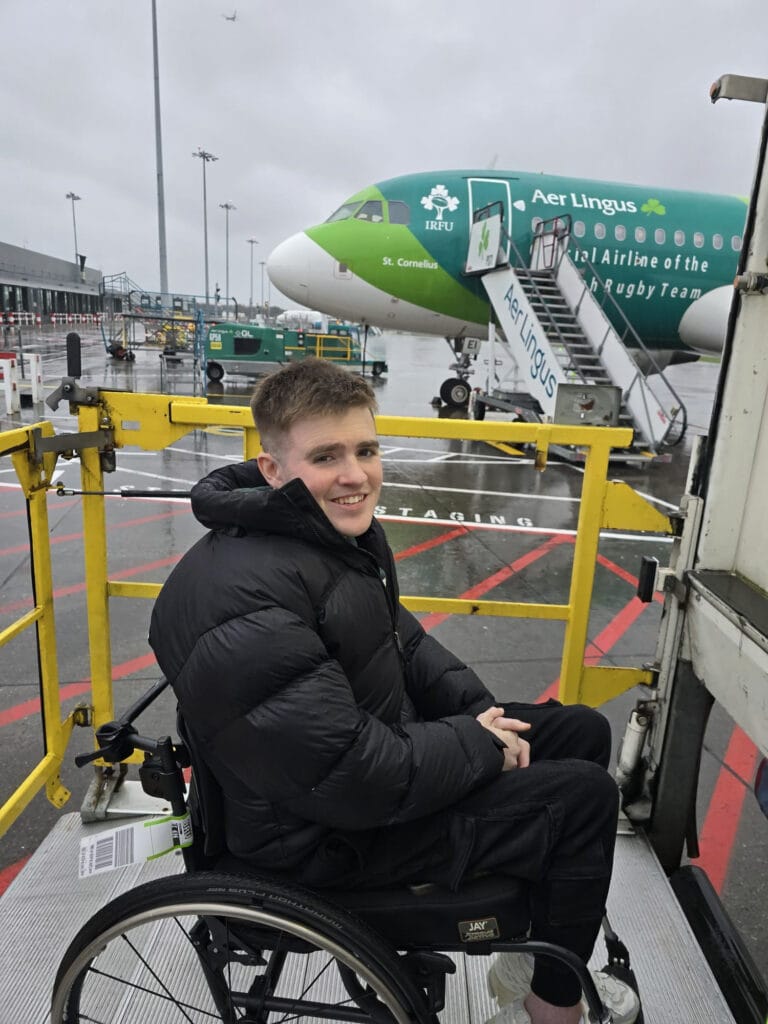
Once the ambulift is up, the assistance team transfers me into an aisle chair and straps me in. An aisle chair is a specialized, narrow wheelchair that goes down the narrow airplane aisle to get you to your seat if you can’t walk or have limited mobility.
The assistance team knock on the airplane door and wait for the cabin crew to open it. Once the door is open the assistance staff bring me to the row my seat is in and I transfer to my seat.
Just a little tip: take off your wheelchair cushion before letting the assistance team take your wheelchair to storage, in case the cushion gets lost. Store your cushion in the overhead lockers or sit on it when on the plane.
In some cases, you can take up to two personal-assistance devices on board with you in the cabin (e.g., a wheelchair and a pair of crutches), but this is provided that there is enough space in the cabin and that they are not prohibited by the rules on transporting dangerous goods. This may be the case for some electric wheelchairs, because of the type of battery they use.
I have never stored my wheelchair within the cabin — it’s always been underneath the plane. I make sure to say I need my own wheelchair to transfer into at the door of the aircraft, as sometimes they bring your wheelchair to baggage and give you a generic airport wheelchair for deboarding.
This boarding process is very similar when using the tunnel. You usually get brought to the airplane door; the aisle chair is waiting beside the door, and the staff transfers you there.
On European flights I usually book the window seat, as it’s easier for me then having people hoping over me to get to the bathroom in the air. But if you can’t slide over, the wheelchair-designated seats are the ones nearest the aisle as they are easiest for the staff to transfer you to your seat.
Unfortunately, on most of these flights the bathrooms aren’t accessible. Toilet-wise I just hold it until I get to my trip location.
Once at your seat sit back, relax and chill —just make sure to turn your phone on to airplane mode!
Back on the ground
Once you land you just must wait until the seat belt sign is off.
Once the sign is off, the process can be a little frustrating. Everybody else may be getting up and getting their bags down from above and lining up in the aisle to get off. But you have to wait in your seat. In my experience, they let everyone else off before the assistance gets on the aircraft. This can be quite frustrating sometimes as you are last getting to baggage and just hope nobody took your bag! I suggest you put something on your bag like a tag, especially if it’s a plain color.
When assistance arrives I get transferred to the aisle chair, then assistance takes my carry-on bags — and of course my cushion — and I transfer into my own wheelchair in the ambulift. I get brought through the passport check, and then I usually tell the assistance I’m ok from here.
I go to baggage and collect my bags. If, unfortunately, your wheelchair was to get damaged, I would go to the airline desk before leaving the airport and report it to them.
This is my experience when flying within Europe. I find air travel to be great for getting from place to place but unfortunately there is along way to go until it truly is accessible for all.
Sign up here to get the latest news, perspectives, and information about DMD sent directly to your inbox. Registration is free and only takes a minute.
