
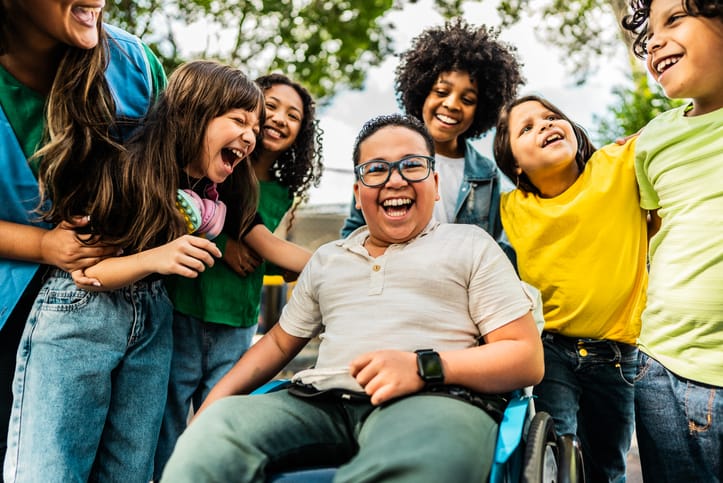
If you are the parent of a child with Duchenne muscular dystrophy (DMD), you regularly talk with their healthcare team about symptoms, medications, physical rehabilitation and more. But sometimes, in time-pressed settings, doctors never come around to actually talking about one of the most important parts of childhood: making new friends.
The challenges to making friends
The process of making friends and learning how to deal with the turbulence that comes with it is an important part of growing up. However, children with DMD often find it difficult to make friends. There are a few reasons for this.
The unique challenges associated with DMD often make it more difficult to make friends. Limited mobility and fatigue can make participating in games and sports a challenge. Since young boys are known to enjoy running around and generally being physically active, not being able to join in can feel deeply isolating.
Having different physical abilities, using mobility aids and frequently leaving school for hospital visits can also send a silent signal to your child’s peers and classmates that they are different. If your child lacks confidence, this can be quite a blow, and you may notice your child slowly retreating into himself.
Physical differences aren’t the only challenge. From ADHD to the everyday stress of living with a chronic disease, DMD’s mental impact can also make it difficult to focus on conversations and fully connect with others.
Read more about DMD testing and diagnosis
Ways to help a child with DMD make friends
Thankfully, there’s steps you can take to help your child develop and maintain friendships.
Reach out to their school
It may be worth having a chat with your child’s teachers. Teachers are typically trained to be sensitive to these matters and can subtly encourage participation in group activities without singling anyone out. They may also be able to make small changes that help your child feel less isolated, such as using chairs during “circle time” so a child in a wheelchair doesn’t feel as different.
The school may also be able to help adapt sports so your child can participate, or give your child the role of scorekeeper or assistant coach.
Find adapted activities
Sports and hobbies are a natural way to make friends. A few changes can make them more accessible to those with DMD.
Research if there are any adaptive sports groups you child could try, such as a powerchair hockey league. Local organizations for people with disabilities may be able to provide a list of options. Your child’s physical therapist can offer guidance on which adapted sports might be the best fit for their needs.
For many boys with DMD, gaming is a favorite way to spend time with friends — but it takes a degree of dexterity that becomes more challenging over time. Accessible gaming, which uses lighter controllers, larger buttons and other adapted elements, can help level the playing field.
Offer your support
Children need a lot of encouragement, and it is no different for a child with DMD.
Let your child know that friendship comes in different forms, and that he should take his time in exploring them. For example, your child may find that activities that are less physically intense may suit him better, such as reading or playing chess. In a class full of children, he is bound to find one or two other friends who share the same interest.
Trying to balance work, care and worries about the future often means you might feel distracted. It’s important to slow down and take time to actively listen to your child. Learn what’s helping, what’s not and what support they need.
Sign up here to get the latest news, perspectives, and information about DMD sent directly to your inbox. Registration is free and only takes a minute.
